
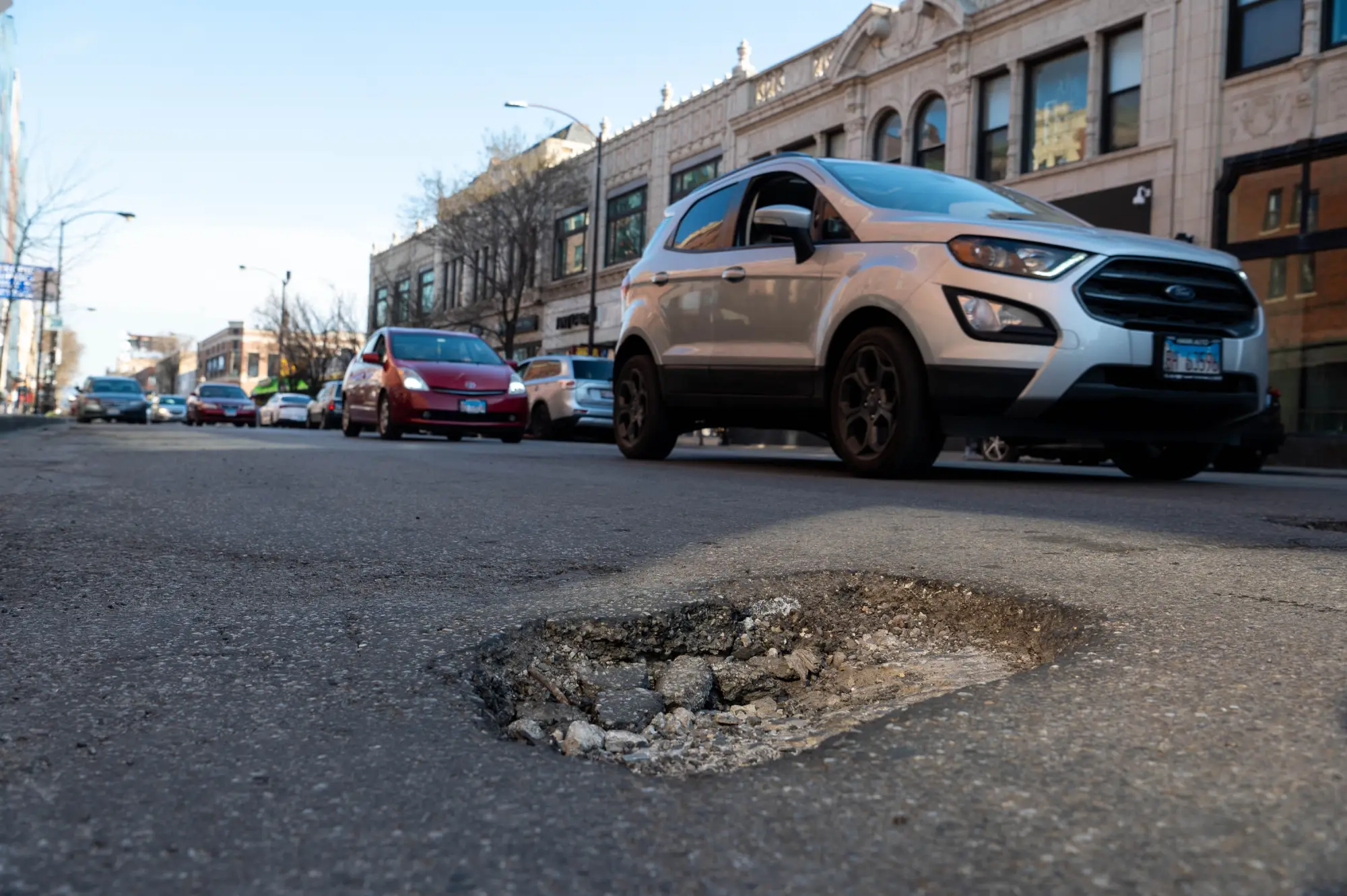
Vehicles drive along North Milwaukee Avenue near West Diversey Avenue.
- Local Government
How to File a Pothole Claim with the City of Chicago
Pothole damaged your car? Here’s what you need to submit a claim, how the city reviews it and what reimbursement may actually cover.
· Updated
Six months ago, Carlada Thomas was driving home from Aldi when her car’s tire struck a pothole. Though she’s only lived in the Austin neighborhood for three and a half years, this wasn’t Thomas’s first time she popped a tire from a Chicago pothole.
“I’m not looking for potholes. I’m thinking it’s supposed to be safe on the street,” Thomas said.
Then, her tire bounced. “I’m like, ‘Are you serious?’” she said.
It is serious: Potholes are caused by extreme weather fluctuations. Water seeps into pavement, expanding when it freezes and contracting when it thaws. This “flexing of the pavement,” combined with melted water and tons of cars on the road, causes “pavement to deteriorate and potholes to form,” according to the city of Chicago’s website. Salt, too, is rough on our city’s pavement.
So potholes are a fact of life. If you run over one and are hoping to be compensated, first determine whether you’re going to make a claim with your insurance company.

File your claim — and keep tabs on it.
If the answer is no, and you’re hoping to be compensated by the city, you’ll need a few things: A receipt for the repairs performed to the vehicle or two written estimates for repair, a letter from your insurance company stating you did not file a claim with them if it’s over $500, and copies of your driver’s license and insurance card.
File your claim to the city clerk’s office by either using their online portal, mailing the forms, or dropping them off in person at 121 N. LaSalle St., Room 107. Check on your claim by searching your name on the City Clerk’s Electronic Legislative Management System.
You can also report a pothole to the city even if you didn’t run into it by visiting the site’s 311 page.
Between 50 and 75 pothole claims are introduced to city council each month, says Kevin Kimmel, staff assistant at the city of Chicago. But not all are approved. If any of the required items are missing from the claim packet, it will be rejected before it’s moved on to the Committee on Finance. Before submitting a claim, it could be helpful to look at denials publicly available through the journal on the City Clerk's website beginning on page 167.
You can contact the Committee on Finance at 312-744-8861 or at smallclaims@cityofchicago.org to follow up on the status of a claim.
Understand what the city may reimburse.
If your claim is accepted, there are still a few more hurdles to get past. First, the appropriate user department — like Streets and Sanitation or Transportation — will investigate. Then, the Committee on Finance takes over. If the claim is approved, it’s sent to the Department of Finance to do a debt check. If you owe the city money for unpaid fines or tickets, that amount will be deducted from the pothole claim.
For accepted claims, you’ll get 50% of the value of the damaged parts (not replacement cost). The idea is that drivers share some responsibility to avoid potholes and other road hazards. Additionally, depreciation is taken on parts 5 years and older, according to the city of Chicago’s Small Claims website.
In rare cases, insurance deductibles and the cost of a tow are covered at 100%.
Unfortunately, Thomas had no idea this program existed. She said she’s seen many potholes go unfilled. But now that she’s aware, she can report ones she spots — and perhaps get compensated should she, heaven forbid, hit one again.