
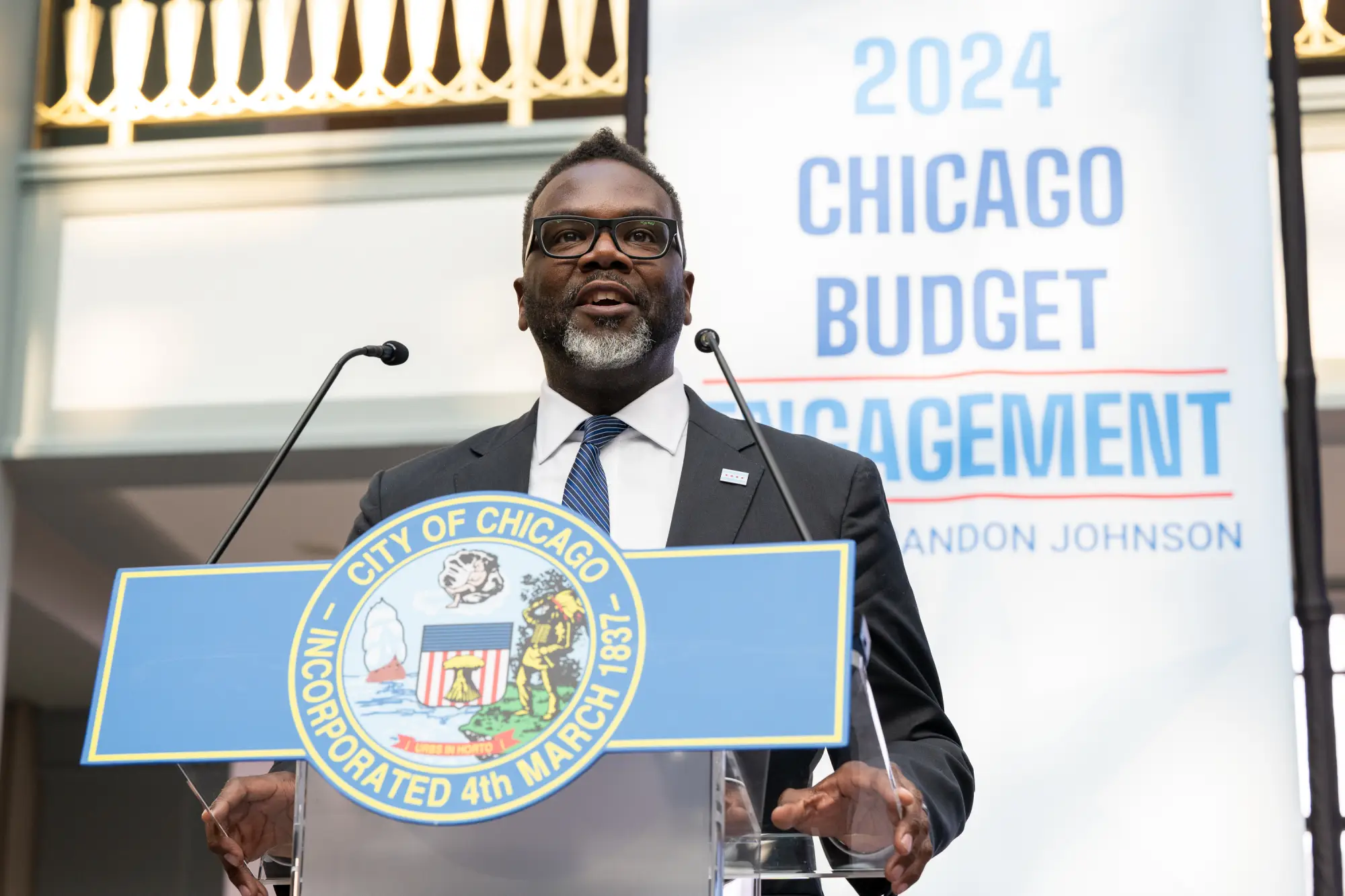
Mayor Brandon Johnson talks to students about the city's budget youth roundtable in 2023.
- Local Government
How to Influence Chicago’s Participatory Budgeting Process
Every Chicago ward gets $1.5 million annually for local infrastructure. Here’s how to weigh in on how those funds are spent.
It might surprise you to learn that you can play an active role in identifying needs and choosing projects for your ward through a long-running but little-known program to fund infrastructure improvements.
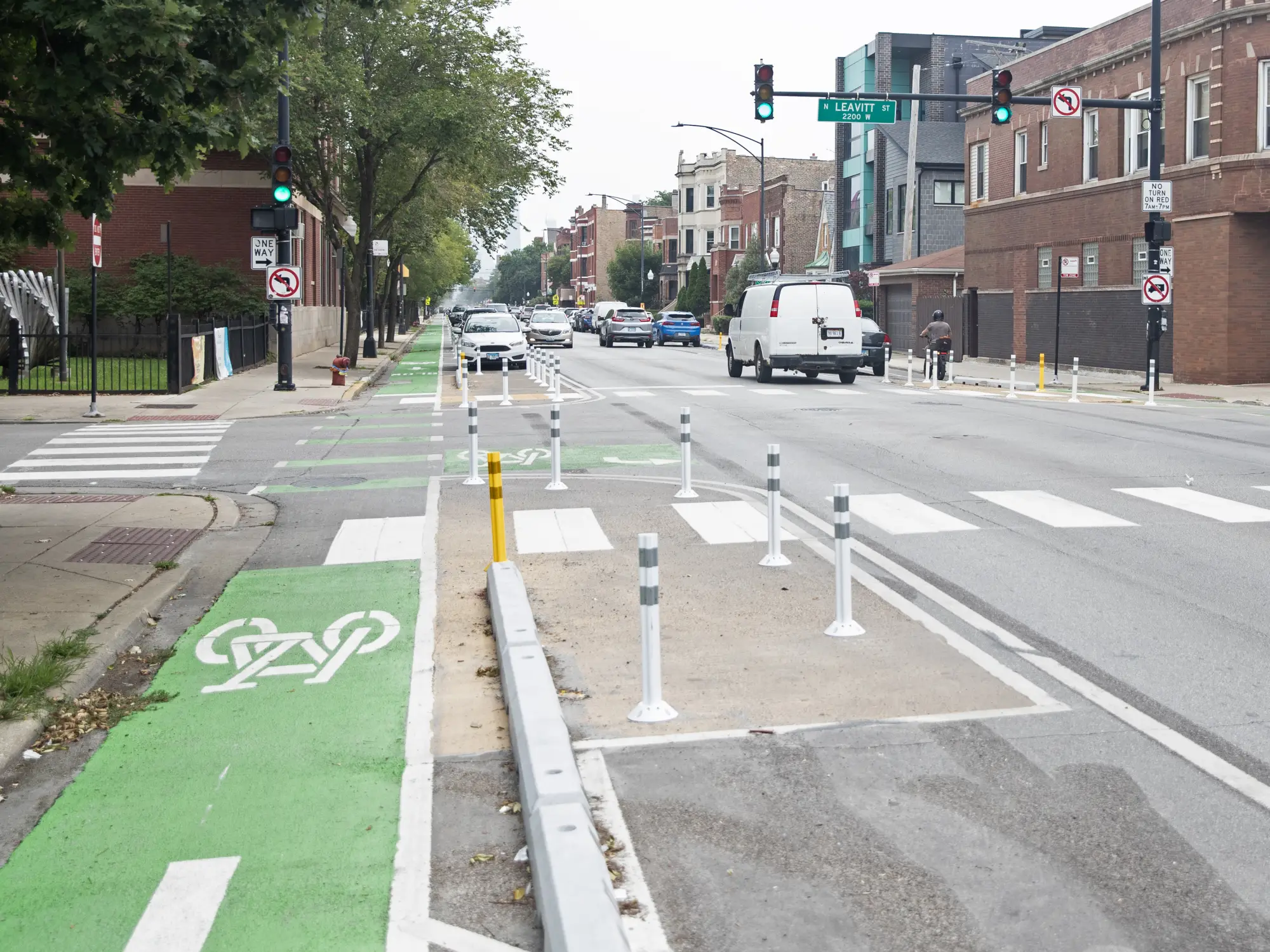
The Aldermanic Menu Program began in 1994 and allocates $1.5 million annually throughout the city. Each of Chicago’s 50 wards receives the money in capital bond funds to use for infrastructure projects such as street repaving, sidewalk repair, pedestrian safety, bike lanes and park upgrades.
Know what the menu money can fund.
Every year, the Chicago Department of Transportation and the Office of Budget and Management provide alders with a list of acceptable projects. These offices will also help evaluate feasibility and cost.
Menu money must be spent on infrastructure — no exceptions. Applicable projects include (but may not be limited to) speed humps on streets and alleys, alley aprons and green alleys, street bump outs, curbs and gutters, lighting and greenways. Some park projects are considered and even qualify for matching funds. The alderperson’s office will be best able to advise on what is acceptable.
Find out how your ward makes decisions.
There are essentially two methods for allocating menu money. First, the alderperson or ward office can identify and shepherd improvement projects through to completion, usually with some input from residents. Others have implemented something called Participatory Budgeting, which uses an established process for residents to submit, evaluate and vote on what gets funded in their ward.
Alders use a variety of means to assess and allocate funds. To find out how to get an issue or project considered, first consult your local ward office via their website or a call. Each ward has a somewhat different process.
Some do outreach to residents at neighborhood events, street festivals, farmers markets or other scheduled meet-and-greets. Many host town halls and regular meetings to update neighbors on community issues. Still others have online polls and forms to submit a pet project for consideration.
Submit an idea — or make the case in person.
The 49th Ward on the city’s Far North Side launched Participatory Budgeting in 2009, though only a handful of wards use the process. To find out if yours is one of them, call your ward office to get details on how to get a pet project considered for funding.
Many wards have a hybrid version, allocating some money to resident-selected projects while holding back some menu funds to use at the alder’s discretion. “Of the $1.5 million, we have neighbors vote on how to spend $1 million and reserve $500,000 for our team to allocate as needed for emergencies, such as curb and gutter work,” says Nicole Granacki, chief of staff for 48th Ward Ald. Leni Manaa-Hoppenworth.
Residents can submit suggestions to the ward website at any time or attend one of several community workshops throughout the year. Projects are evaluated for feasibility and engineering needs and voted on. Recent improvements include a raised intersection near Senn High School and Pierce Elementary. “Our brainstorming raised safety concerns [there] and CDOT [Chicago Department of Transportation] recommended this as a solution,” Granacki says.
Follow the money and join forces with your neighbors.
Want to know where your wards’ menu money went, or if it was used at all? The city’s website hosts an annual report with a list of projects by ward. Though it’s not a complete accounting — residents can contact their ward office for a more thorough list — the city’s site provides a glimpse into the types of improvements that are prioritized and how much they cost.
For example, the report shows that the 46th Ward used $26,139 on sidewalks (for the very block where this reporter once lived), committed $115,281, and carried over the balance to use in the next year. But according to Jesse Orr, director of infrastructure and development for the 46th Ward, all of 2025’s $1.5 million was spent, primarily on sidewalk projects during the alderwoman Angela Clay’s first year in office.
“We asked neighbors to tell us where their hazards are,” says Orr, citing broken pavement, icy spots and tripping hazards. “Resurfacing and alleys were named by residents but this first year we focused on sidewalks.”
On the 4800 block of Kenmore, which received menu money, “We did an infrastructure walk with members of the block club,” Orr says. “A lot of these things have been long-running pain points, and we wanted to first fix some of these existing hazards.” In coming years, the focus will shift to other infrastructure needs, he says.
Menu money isn’t a “use it or lose it” program. Funds can carry over from year to year, adding to available money each annum. And some projects qualify for matching funds that ward offices can tap into.
Anthony Pence, president of the Edgewater Triangle Block Club Association in the 48th Ward, worked on this year’s projects with the alderperson’s office. “There are a lot of things in the city you can criticize, but this is a way you can make incremental improvements to your neighborhood, and some of these changes are going to last decades,” he says. “If you have a local block club or neighborhood association, join it. If you’re experiencing an issue, likely others are as well.”
Mary Frances Charlton, president of the Ainslie Winmore Block Club, agrees. “It’s definitely an underutilized resource,” she says. And while you don’t need to be in a block club to access menu funds, volunteer groups can help to coordinate efforts with local alders. Charlton’s block club straddles the 46th and 48th wards and has worked with both ward offices. It was instrumental in identifying the sidewalks most in need of repair in the 46th.
“We all walked the blocks together to identify the areas,” she says. “This is all volunteer based and one of the most meaningful volunteer opportunities I’ve ever taken on. Being able to keep an eye on sidewalks and make sure that things like that are safe. It may seem like a mundane issue, but it can make a big difference.”