
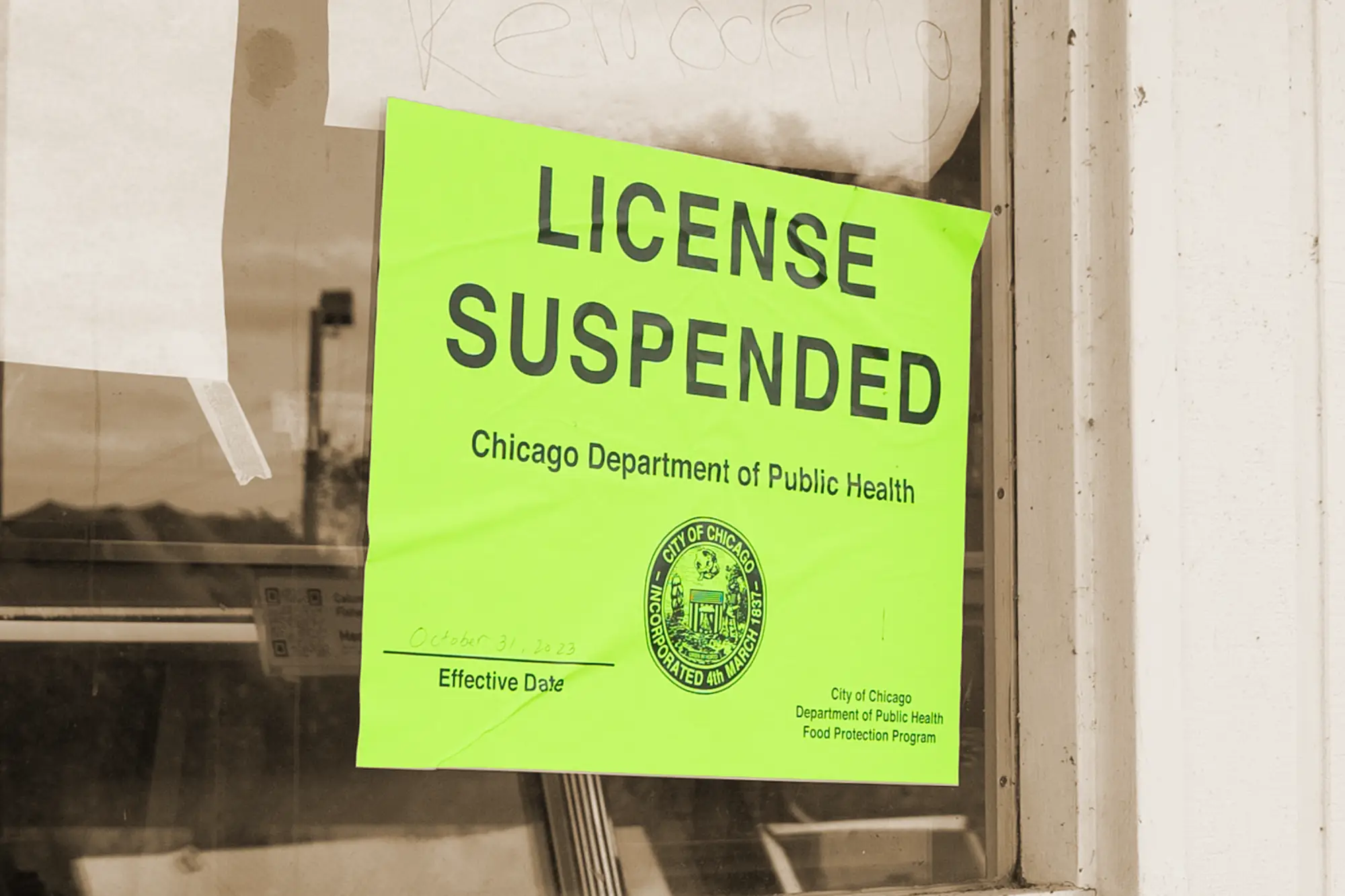
A Chicago Department of Public Health notification hangs in the window of a local business in 2023.
- Food & Drink
- Local Government
How to Read the City’s Restaurant Inspection Reports
Chicago’s food-inspection database is public but complicated. Here’s how to search it, decode violations and spot patterns over time.
· Updated
If you’ve gotten a meal out recently and didn't know that the restaurant or market had a failed health inspection, you would hardly be alone. If you visited an establishment that prompted suspicions that something was awry, sanitization-wise, then you’re likely in even bigger company.
The City of Chicago monitors some 16,000 licensed food establishments, including restaurants, grocers and schools with fewer than three dozen inspectors in the Chicago Department of Public Health.
The city hosts a database with inspection reports and results, but it’s difficult to navigate and even more difficult to understand. Further complicating things is the sheer volume: The public database tracks nearly 100,000 inspections.
Find the report in the city’s database.
The city’s portal dates back to January 1, 2010. There are sections to report a problem and another that uses data to help predict future inspections.
The data is updated frequently, and search parameters allow for filtering by date ranges, ZIP code, inspection and facility type. All of this information is viewable in a clear map of the city, which can be searched by area, much like maps on a mobile phone.
For example, a search for inspections performed in July for the downtown area (ZIP code 60601), reveals that 19 inspections took place. Just below the interactive map is a spreadsheet-style listing with 17 columns.
Know which violations signal the biggest risks.
“When you read a restaurant inspection report, understand that not all violations carry the same level of risk,” says Jasmine Davenport-Murray, a registered environmental health specialist and CEO of Chicago-based ARF Food Safety Consulting Group.
The most serious are “priority violations.” These are the most urgent conditions that can make people sick, such as cross contamination between raw and ready-to-eat foods, food held at unsafe temperatures and a lack of hot water for employee hand washing.
Next are “priority foundation” violations, which include cockroaches, rodent droppings, missing posted employee hand-washing requirements and a lack of a certified food protection or sanitation manager on premises. Illinois requires that such a manager be present “at all working hours making sure these procedures are followed,” Davenport-Murray says.
This means that every person who handles your food, even at a sandwich shop, must take a two-hour food-safety course. On-site certified food sanitation managers take an eight-hour course. If an inspector catches the lack of such a manager, “they will be fined and reinspected within a week,” Davenport-Murray says.
“Core violations” are on the less concerning end of the spectrum. These are related to maintenance and cleaning, don’t typically present an immediate health risk and often are related to the age and condition of the building itself. “If you see broken tiles and flooring, it’s not such a big deal,” Davenport-Murray says. “However, if a restaurant has a lot of core violations, it’s a sign that maintenance isn’t being kept up.”
Understand why — and when — inspectors show up.
City inspectors have a wide range of responsibilities and cover much more than restaurants. Inspectors visit any facility with a food-service operation, including schools, food trucks, hospitals and other care facilities. They also inspect festivals and events, of which Chicago has some 400 annually.
There are new-license inspections for soon-to-open facilities and re-inspections of those same facilities, as many do not pass on their first try. There are complaint inspections for when a customer calls in a concern or potential violation — and the re-inspection to make sure any violations have been addressed. And finally, there are routine inspections that occur as a matter of course throughout the year.
With so many designations and locations, some places fall through the cracks. Carts on corners and parks, for instance, are not listed in city reports. Some prepared food businesses that use shared commercial kitchens — so-called ghost kitchens — can be difficult to identify in the database as business names change. That means that some food carts aren’t inspected, but if their food is prepared in ghost or commercial kitchens, their food and procedures will be examined in routine inspections.
Look beyond a single inspection.
"Read the follow-up reports and note how many times [an establishment] has had a violation," advises Mitzi D. Baum, CEO of Nourishing Hope, a Chicago-based food pantry, mental health and social services provider and former CEO of Stop Foodborne Illness.
Even the cleanest restaurants can have violations. Chicago buildings are old, alleyways are shared and bugs and rodents will sometimes find their way in. It's the type and frequency of a violation that is the bigger concern, says Davenport-Murray. “You’re looking for patterns over time and this gives you a picture of how serious the restaurant is about sanitation.”
Establishments have seven days to rectify violations and reports will show these actions and assessments.
Report a concern when you see one.
Violations are often uncovered by observant patrons. “Never be afraid when you go to a restaurant and you see something, say something. Call 311 or report via the Chicago 311 portal,” Davenport-Murray says. “Because [the establishment] may not even be aware.”
Baum agrees. “You should be an informed consumer,” she says. “People go out to restaurants and they never sit down and think ‘Is my food safe?’ The expectation and the trust, is that it is.” But that’s not always the case.