
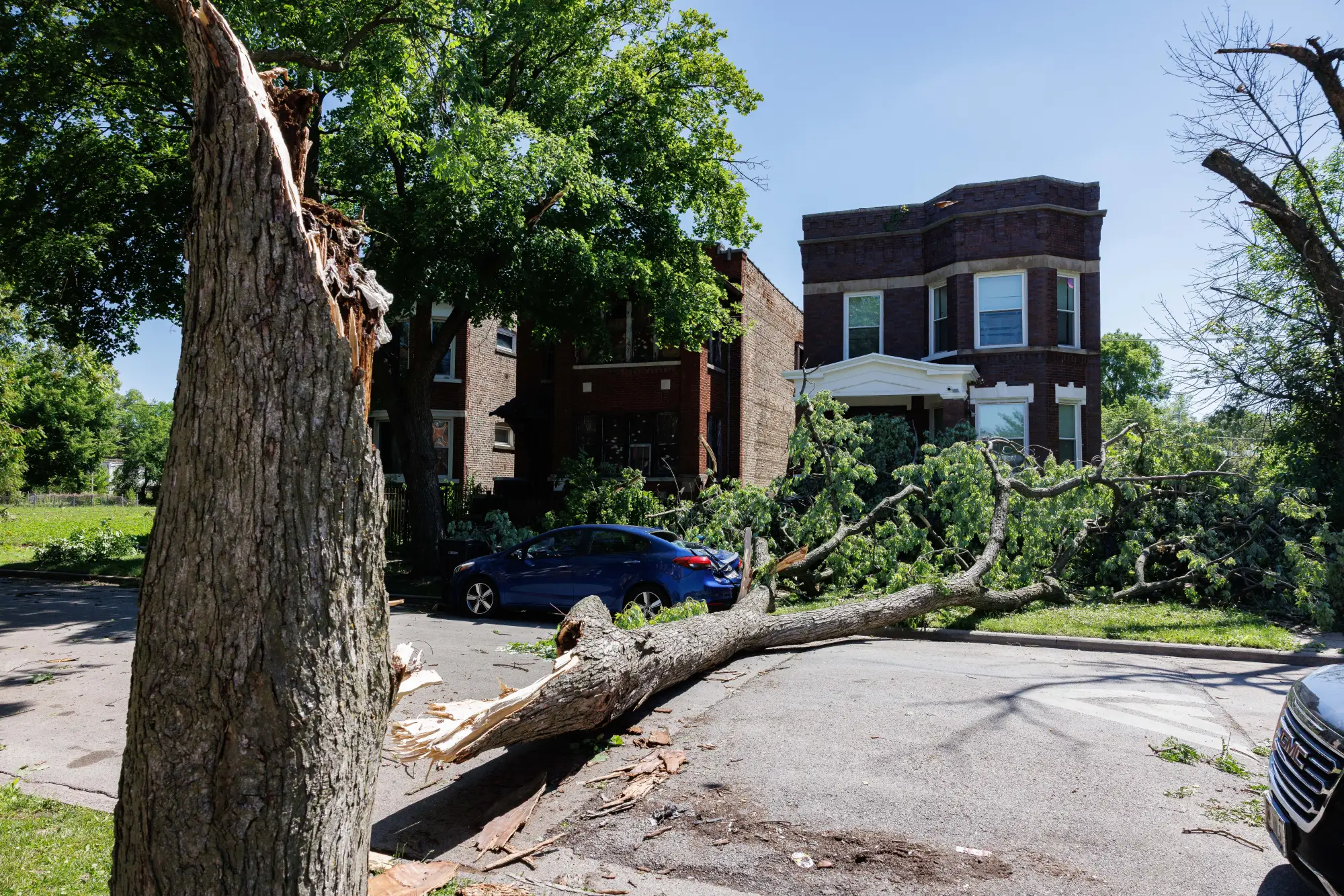
A fallen tree covers the roadway on the 7000 block of South Green Street in Englewood, Friday, June 12, 2026.
- Local Government
- Nature & Outdoors
How to Report a Parkway Tree Emergency
An overgrown parkway-tree limb can be dangerous. Here's when to call 311 — and when to request routine service instead.
Following a seasonal bout of severe storms, you might wonder who to call about parkway trees whose limbs look like they’re about to crash into your car or, worse, your house.
Parkway trees are those found in the public right of way, typically between the street and the sidewalk in Chicago neighborhoods. Chicago has more than 500,000 parkway trees, and all of them are maintained by the Bureau of Forestry.
Call 311 for an immediate threat.
If it looks like that limb could fall tomorrow, or has already fallen, the place to start is the city’s 311 service, where the Chicago Department of Streets and Sanitation Bureau of Forestry handles requests for tree emergencies.
Tree emergencies “are downed trees, hanging limbs, or tree damage that threatens public safety,” said Ryan Gage, Director of Public Affairs for the Chicago Department of Streets and Sanitation.
In tree emergencies, the Bureau of Forestry “coordinates the removal of parkway trees or trees in the public way that are dead or damaged. We prioritize addressing tree issues that constitute an emergency situation,” Gage said.
The top goal is to clear the roads, Gage said. From there, crews prioritize tree removal based on the extent of the emergency.
“If you’re the person with a tree in their yard for two weeks it’s a headache,” he said. But if it doesn’t threaten property or safety, it’s “not the most urgent.”
What city crews emphasize when it comes to tree emergencies, Gage said, “is patience. Storms and storm damage, to put it mildly, is an inconvenience for everyone. When we have those super damaging storms like we had in June and July, we appreciate the patience to address everyone’s needs.”
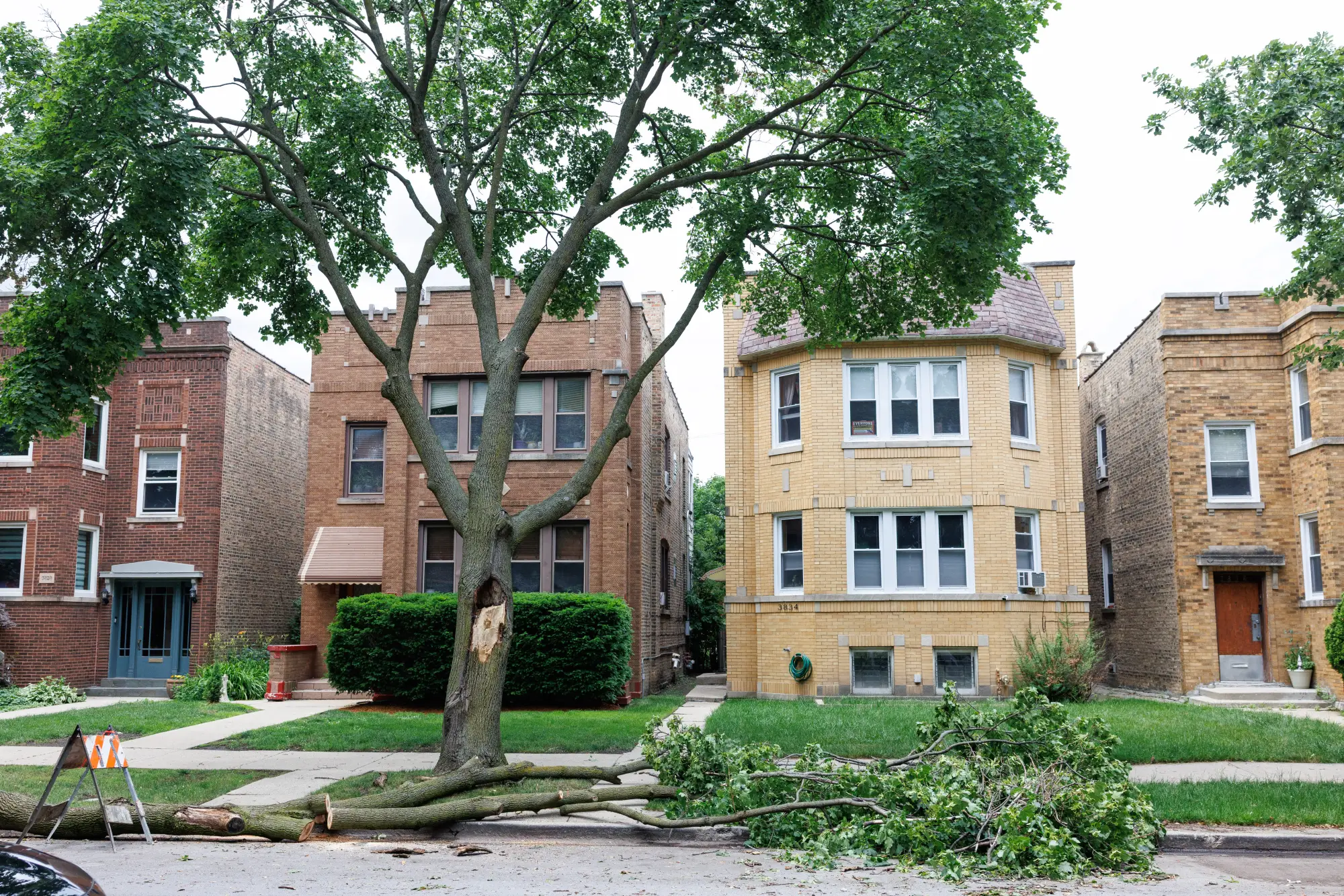
Request routine trimming separately.
If your problem is not an emergency tree but a healthy one that needs to be cut back, the Bureau of Forestry handles that too. But the bureau staff won’t cut down a tree just because it makes you nervous. Instead, staff visits every ward in the city on a schedule from April to December to maintain Chicago’s urban tree canopy.
If the limb looks like it just needs some maintenance, that’s not an emergency and can be reported online.
Along with asking someone to take care of your existing trees, you can request new trees be planted to replace the ones toppled in the latest storm by calling 311 or submitting a request online. In addition, as part of the Our Root Chicago program that launched in 2022, the city is proactively planting 75,000 trees around the city by 2027.
If the tree is on private land, however, it is your responsibility to find someone to take care of it before it harms yours or someone else’s property. While insurance could cover the damage, it’s best to avoid the time and hassle.
Replace lost trees — and plant for the future.
Chicago has a long history with its urban canopy. Experts say the region’s trees provide $416 million in benefits like energy cost savings, stormwater mitigation and air purification. Unfortunately, the city used to plant fast-growing, non-native trees that are not adapted to Midwestern storms.
Those are often the trees that topple when heavy winds blow through and historically were popular with urban planters. Native trees, like sassafras, flowering dogwood, American Elm or tulip poplar make better choices and are genetically better dispositioned to survive our heavy winds, rains and snowstorms.
The city has a list of trees identified as “urban tolerant trees,” suitable for our area. It can help guide property owners and city crews as they decide to plant a new tree on their own land. Choosing the right tree now means that someone living on your block decades into the future can enjoy the tree and not be calling the city because it crashed onto their car.