
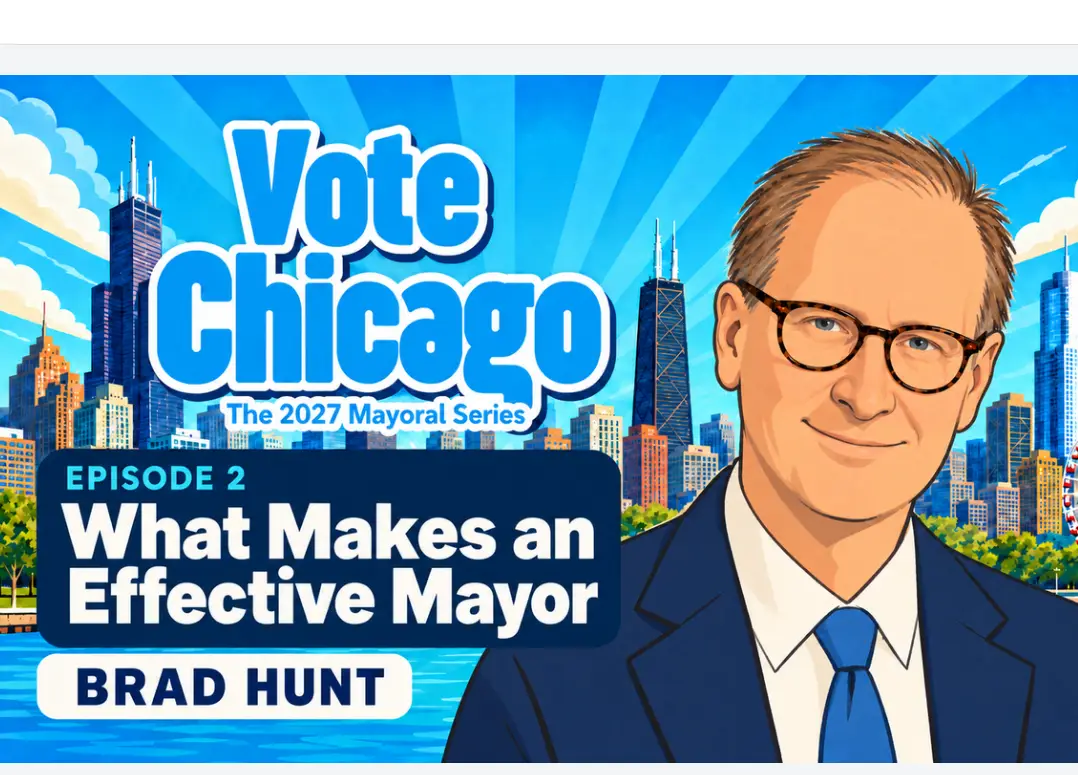
Listen to Vote Chicago Episode 2: What Makes an Effective Mayor
Historian Brad Hunt traces two centuries of mayoral power, and Ashley and Jessie share a four-part framework for evaluating candidates.

Play Episode 2 on Substack, listen on Apple Podcasts or Spotify, or watch on YouTube.
A snowstorm, a parking meter deal, a struggle over who gets a voice at City Hall. Chicago’s history offers concrete lessons about what the mayor’s job demands and what happens when leadership falls short.
Historian Brad Hunt, a professor at Loyola University Chicago, joins Ashley Hartman to trace the evolution of mayoral leadership across nearly two centuries. The conversation moves from Chicago’s early weak-mayor system to the rise of the Democratic machine and the different ways more recent mayors have built and used power.
Hunt explores the relationships that allow a mayor to act: with City Council, neighborhood leaders, labor, business, Springfield, and Washington. Through examples from the administrations of Richard J. Daley, Jane Byrne, Harold Washington, Richard M. Daley, Rahm Emanuel, and others, he considers why some coalitions hold together and others fracture. He also examines the tension between political loyalty and professional expertise, and how the handling of a crisis can change public trust.
The discussion keeps the costs of governing in view. Large projects and downtown investment may bring benefits while excluding residents from decisions or imposing lasting burdens on neighborhoods. Hunt’s account invites listeners to look at both what a mayor accomplishes and who benefits or bears the cost.
After the interview, Ashley and co-host Jessie Dadosky present their own four-part framework for evaluating mayoral candidates: delivering basic services, building and sustaining coalitions, driving growth, and inspiring a shared vision for the city. They treat equity, inclusion, and long-term fiscal health as questions that run through every part of that framework.
The goal is to give voters a more concrete lens for the interviews ahead: what the office requires, how a candidate would work with others, and whether their plans can translate into results across Chicago.
In this episode
- How Chicago’s mayoral power grew through political relationships and institutions.
- Patronage, professional expertise, and the challenge of accountability.
- What past crises and major deals reveal about judgment and public trust.
- Downtown investment, neighborhood needs, and the costs of exclusion.
- Ashley and Jessie’s four-part framework for assessing mayoral leadership